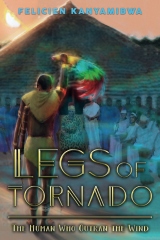
Legs of Tornado: The Human Who Outran the Wind, available on Barnes and Noble


Legs of Tornado

ASIN: B01J4CU2ZW


Special Pricing at Barnes Noble

Overview

Maguru is Rwanda’s best hunter, even better than the king—and certainly better than his jealous village chief. He’s hunted the buffalo, the antelope, and the leopard, but he has never hunted the deadly beast. To save his people, Maguru must now learn to outwit a creature that can change shape in the wink of an eye. If he succeeds, he’ll be a hero. If he fails, his people will die of starvation. Maguru is determined not to fail. Beautifully illustrated, Legs of Tornado introduces readers to the world of African fables, where magic lives and breathes, and beautiful brides hide deadly secrets.

Sample Chapter

Maguru ya Sarwaya, Legs of Tornado, was a very strong-willed and mindful boy. He was very polite to all people and kind to other boys and girls in the village. He respected older persons and revered elders. When Maguru was still a baby, his fearless father was killed while hunting buffalo. As a result, he was raised by his single mother, whom he deeply adored and cherished. Most parents wished Maguru, or Legs, as they called him, were their own son.
As Maguru grew up into a young man, his prowess and hunting skills amazed his childhood friends.
Maguru came to be one of the most respected hunters in his village. He became a better hunter than his father had been and more skilled than the chief of the clan was. He could hunt the buffalo, outrun the antelope, and track the leopard. Within his and neighboring villages, Maguru’s hunting acumen dwarfed that of the king’s. Wiser hunters were awed by Maguru’s precocious hunting talents. Only the village chief grew jealous as Maguru’s popularity spread.
Continues...
Excerpted from "Legs of Tornado" by Felicien Kanyamibwa. Copyright © 2016 by Felicien Kanyamibwa. Excerpted by permission. All rights reserved. No part of this excerpt may be reproduced or reprinted without permission in writing from the publisher. Excerpts are provided solely for the personal use of visitors to this web site.

Author Profile


Share:

Legs of Tornado: Available on Amazon Worldwide and Other Distribution Channels

To those who have asked about how to get the book, "Legs of Tornado - The Human Who Outran the Wind".
 The book  is now available on the following distribution channels:


To find the book on Amazon, access the web site by clicking on the link. If the book web page in not readily available, enter: "Legs of Tornado" in the search field.

 I remain humbled by, and thankful for, the  overwhelming and enthusiastic response from friends, readers, and simply those who delight in discovering African culture and mythology.

Thank you all who have bought the book. I truly believe that children, juvenile, parents and grand-parents who did not read the book, yet, will enjoy it greatly when they do.

For more, also continue to check Legs of Tornado site at http://www.legsoftornado.com

Felicien "Aroni" Kanyamibwa.
Share:

Legs of Tornado - The Human Who Outran The Wind

Legs of Tornado
 

The Human Who Outran the Wind

Authored by Felicien Kanyamibwa, PhD, MqBA
Edition: 1
Legs of Tornado

List Price: $14.99

Add to Cart
About the author:

US citizen Felicien Aroni Kanyamibwa, PhD, was born in Rwanda. He grew up in both Rwanda and the Democratic Republic of the Congo.

Kanyamibwa received his PhD in business administration from Penn State University, University Park. He also holds an MS in quantitative business analysis and management information systems from Louisiana State University.

While in Rwanda, Kanyamibwa worked as a senior executive in the banking, manufacturing, and civil engineering industries. In the United States, his professional career has included teaching at the university level and fulfilling executive roles for various technology, financial, and pharmaceutical companies. He has been published in both academic and professional journals.

When not writing, Kanyamibwa enjoys reading; exploring ethnic, modern, and classical art and music; and telling stories from his homeland.


Long ago, the people of Rwanda suffered through a terrible famine. The rains did not come to help the crops grow, the grass withered, and the soil became so dry that it cracked.

The people looked to their village chiefs for guidance, but the chiefs could not help. They looked to the king, but he could not bring the rain. Only the magical tail of a mystical creature could save the kingdom.

Maguru is Rwanda’s best hunter, even better than the king—and certainly better than his jealous village chief. He’s hunted the buffalo, the antelope, and the leopard, but he has never hunted the deadly imparambwe.

To save his people, Maguru must now learn to outrun the wind and outwit a creature that can change shape in the wink of an eye. If he succeeds, he’ll be a hero. If he fails, his people will die of starvation.

Maguru is determined not to fail.

Beautifully illustrated, Felicien Aroni Kanyamibwa’s Legs of Tornado introduces readers to the world of African fables, where animals talk, beautiful brides hide deadly secrets, and magic lives and breathes.


Publication Date:
Jul 15 2016
ISBN/EAN13:
1533345066 / 9781533345066
LCCN:
2016909664
Page Count:
46
Binding Type:
US Trade Paper
Trim Size:
6" x 9"
Language:
English
Color:
Full Color
Related Categories:
Juvenile Fiction / Fairy Tales & Folklore / Country & Ethnic / General
Share:

Legs of Tornado: A Tale About Overcoming and a Tribute to My Mother Esther

Legs of Tornado

The Human Who Outran the Wind

Get your copy from Amazon by clicking here: Add to Cart
        This is the tale of Maguru ya Sarwaya, Legs of Tornado, the human from a humble upbringing who outran the wind, defeated evil spirits, overcame his fate, became a respected clan chief, and triumphed ever after.
        As an infant, I was first told—and often told again—this tale by my own mother at bedtime. Then, my older siblings added their own versions when my mother was not around.
        Now, I am sharing my memory so that you, the reader, can build your own.

by Felicien Kanyamibwa, PhD, MqBA
Maguru, the greatest hunter in the Kingdom of Rwanda, has tracked the elusive imparambwe and claimed her magic tail as his prize. With it, his king can now command the rain and end the drought that grips the land. When the imparambwe swears to kill him, Maguru laughs at her threats.
Maybe he shouldn’t have done that.

With her magic tail stolen, the imparambwe has lost most of her power−but she has more than enough left to seek revenge on the young man. Now hunting the hunter, she will use every trick she knows to destroy him. Maguru had best beware, or he’ll lose his life, and the drought will never end.

An African fable, Legs of Tornado tells the tale of Maguru, a humble orphan who has a chance to become a mighty chief−if he can outsmart the imparambwe, the mystical beast.


Beautifully illustrated, Felicien Aroni Kanyamibwa’s Legs of Tornado introduces readers to the world of African fables, where animals talk, beautiful brides hide deadly secrets, and magic lives and breathes. 


This story is dedicated to my mother, Esther Nyirabucakara, and to Rwandan war orphans who will never hear nor have ever heard their mothers, sisters, or brothers recount African bedtime tales that have been handed down from grandparents to children for generations.

Photo: Felicien Kanyamibwa, a.k.a, Aroni, with his mother, Esther Nyirabucakara, in Rwanda on October 4, 1986
Share:

Is There Any Oppression that is not Deliberate and by Design?

INTRODUCTION 

The icon of the struggle against oppression, Nelson Rolihlahla Mandela, passed away today December 5, 2013. As the South African President Jacob Zuma said, Although we knew that this day would come, nothing can diminish our sense of a profound and enduring loss. His tireless struggle for freedom earned him the respect of the world.

The death of Nelson Mandela should be an occasion, not only to mourn the loss of the person who epitomizes the success of overcoming oppression, but also to reflect on our own struggles against oppression, wherever it is and wherever and whoever we are.

While thinking about Mandela’s struggle against oppression, one question came to my mind: “Is there oppression that is not deliberate or by design?

The question came to my mind, perhaps because,  lately, I read two converging opinions on the nature oppression in Rwanda, coming from leaders from opposing sides: the Rwandan President General Paul Kagame and Dr. Gerald Gahima, one of his current staunch  opponents.

For Kagame: Oppression of Hutus is by Default, not by Design

In an interview by Jeffrey Gettleman,  the East Africa bureau chief for The New York Times, published in New York Times on September 4, 2013  under the title The Global Elite’s Favorite Strongman, Jeffrey Gettlemen wrote:

When I asked Kagame about this, he first tried to convince me that Tutsis actually don’t dominate politics or business. When I presented specifics: the health minister, defense minister, foreign minister and finance minister are all Tutsis, along with some of the richest men in the country, he acknowledged that Tutsis might enjoy a few advantages here and there, but this was “by default and not by design.” Many Tutsis like him had lived outside Rwanda, where there were more advantages. When I was openly skeptical, he finally said, “This Hutu and Tutsi thing, if you get lost in it,” he said, getting exasperated, “you get lost in the pettiness of the past of our history, and you end up in a mess.””

So, for General Paul Kagame, most of the Rwandan  top government  and  military positions are occupied by Tutsis. Most of the businesses are owned by Tutsis, and almost anything of value is dominated by Tutsis who represent, based on official statistics, close to 10% of the population, while 85% of the population,  the Hutus, remain in abject poverty, can hardly get a position within the government, are excluded from the military, the police, and from owning strategic businesses. For General Paul Kagame, it is by default, not by design. 


For Gerarld Gahima, Oppression of Hutus is not a Deliberate Policy

Then,  independent journalist Jennifer Fierberg published an interview she had with Gerald Gahima, a former leader of the ruling Rwandan Patriotic Front and  Rwandan Attorney General, before he was forced into exile by General Paul Kagame.

In the interview, Gerald Gahima said:  “Unfortunately, though, it is evident resources allocation and control of political power aligned. Poverty in Rwanda has an ethnic dimension. There is an imbalance of power toward Tutsi in Rwanda as well as economic inequalities. I do not agree that there is a deliberate policy to impoverish the Hutu people but there is no doubt that Hutu are discriminated against as well as marginalized in political representation.   Economic inequalities between rural and urban population are quite glaring. A disproportionate percentage of the urban population is typically Tutsi. Urban dwellers have better access to state provided services and a better quality of life where as rural communities, who are predominantly Hutu, live in abject poverty. Relatives of people in power get differential treatment over the children of peasants in terms of access to employment and business opportunities. This is not unique to Rwanda. It happens in democracies as well. There is a historic precedent of ethnic division of economic factors.


There are glaring problems with Gerald Gahima’s arguments. First, the arguments surprisingly support General Paul Kagame’s  premise of “ oppression  by default, not by design”.

For Gerald Gahima, because political power is aligned to Tutsis, then  it is normal that  riches and spoils go to Tutsis.  Since the Tutsis are mostly city dwellers, then they are richer.

Gerarld Gahima  later appears to contradict himself:  Hutus are systematically discriminated against, but there is no deliberate policy to impoverish the Hutu.   

Gahima’s argument begs a question: If Hutus are systematically excluded from all the positions of power, in the government, military, education, businesses, how is not this a deliberate policy of exclusion?

He adds that this is not unique to Rwanda. Granted. It was the same in South Africa’s Apartheid regime, America during slavery, Burundi during the Tutsi reign, and France during  the monarchy.

In Apartheid, the Blacks were excluded to Bantoustans, from government positions, businesses,  best schools, etc.  In Rwanda, Hutus are banned from residing in some areas in the cities, government positions, the military, from receiving grants or scholarship to study in the best schools or abroad. If that is not a deliberate policy, then what would it be called?

Incidentally, Gerald Gahima says that Tutsis were deliberately discriminated against under General Habyarimana’s and Gregory Kayibanda’s regime. 

This then raises another question: did Tutsis become city dwellers after the RPF took power, or were they also the richest under the previous  Hutu dominated regimes,  since they were also mostly city dwellers?

Oppression is Deliberate and by Design

My point here is not to single out Gerarld Gahima, not even expand the already inhumane divide among the Hutu and the Tutsi brothers and sisters.  Instead,  I would like to encourage everybody fighting oppression, in Rwanda or elsewhere, to free themselves from ethnic or group bias and shackles, and face  the reality surrounding oppression.  

Oppression is deliberate, regardless of who is the oppressor or the oppressed.  I believe that there is no such thing as oppression that is not by design. Oppression can only be based on a deliberate policy. In the pre and post independence Rwanda, any ethnic and political oppression could only be the policy of the ruling elite. Currently, the ruling elite appears to be from the Tutsi minority that is oppressing the Hutu majority and other Tutsis that dare to challenge the ruling elite.

Our concrete Proposition For Ending Oppression in Rwanda

Now, the question remains the following: how can we overcome this oppression, deliberately designed by the ruling minority? By following the example of  Nelson Rolihlahla Mandela, after his liberation. Jacob Zuma summarized Mandela’s example very well while announcing the death of the icon: Let us commit ourselves to strive together — sparing neither strength nor courage — to build a united, non-racial, non-sexist, democratic and prosperous” Rwanda.


Share:

Memorandum On The Assassination of Rwandan President Juvénal Habyarimana

WHO ASSASSINATED RWANDAN PRESIDENT JUVENAL HABYARIMANA 

by Felicien Kanyamibwa, Ph.D., MqBA.

       ©1999 Felicien Kanyamibwa.

     1. Introduction

    In April of 1994, the small, central African country of Rwanda broke out into an
uncontrollable civil war when hostile missiles shot down its president’s airplane. The
chaos that followed created headlines around the world throughout that summer. 

    The world was stunned by the violence perpetuated by what the media consistently referred to as normally peaceful people. Because the shooting of the plane was the trigger that spiraled Rwanda into chaos and civil war, in order to understand what happened, it is important to know who triggered these events, and why. However, there has been no investigation conducted by the UN to uncover the identity of the perpetuators of the sabotage of the presidential plane. In order to pursue peace and reconciliation in Rwanda, those who shot down the plane must be revealed and held accountable. 

     2. History 

    In order to understand the significance of the events surrounding the downing of
President Habyarimana’s airplane on April 6, 1994, it is crucial to have at least a
fundamental understanding of Rwanda’s history. Rwanda’s population traditionally
consisted of 85% Hutu, 10% Tutsi, and 5% Twa. For nearly four hundred years, Tutsis, members of the minority ethnic group, headed by a Mwami (king) ruled the majority of the Hutu ethnic group. The Hutus were treated as “peasants”, and did all of the manual work. Colonialists (Germany and later Belgium) accepted the status quo, and did not try to change the fundamental structure of Rwandan society. 
    
    In early fifties, Hutus began demanding a better representation in the governing institutions. This led subsequently to the 1959 social revolution which was accompanied by fighting between the two ethnic groups. Consequently, an estimated 100,000 Tutsis fled to neighboring countries including Burundi, Congo, Uganda, and Tanzania. 
    
    Bloodshed and violence was rampant during this period. In 1962, Rwanda became independent under their new president, Gregoire Kayibanda. The latter was member of the Hutu ethnic group. For the first time, Hutus were permitted to obtain secondary and post-secondary education.

    In 1973, a coup established Maj. Gen. Juvenal Habyarimana as the new president
Habyarimana who started a relatively peaceful era. Under his rule,Tutsis enjoyed peace and economical prosperity. It should be noted though, that Habyarimana did not allow those Tutsis who had fled during the wake of 1959 social revolution to return massively to Rwanda. The reason put forward was that the country was too small to accommodate such massive return. 
    In fact, Rwanda is one of the most overpopulated countries in the world. However, this created tension, and those exiled Tutsis felt, perhaps justifiably, that
they should have had the right to return to their homeland. Meanwhile within Rwanda, ordinary Hutus and Tutsis went to school together, went to church together, worked side and helped build up an infrastructure that was the envy of that whole region of Africa.
 
This account/essay covers the following points:

3. Climate – Spring 1994
3.1 Burundi
3.2 Uganda
3.3 Invasion of Rwanda
3.4 Assassinations in Rwanda
3.5 The Arusha Accord
3.6 Warning Signs
3.6.1 The RPF Battalion
3.6.2 The RPF and the air traffic Corridor
3.6.3 Meeting of the final preparation
3.6.4 Delay Tactics
3.6.5 Dallaire’s Question
3.6.6 Regional Summit of Heads of State on Burundi
4. The Missile Attack on President Habyalimana’s Plane
4.1 The Night of the Assassination
4.2 Different Reactions after the Assassination
4.2.1 Inside Rwanda
4.2.2 Rwandan Patriotic Front
4.2.3 UNAMIR
4.2.4 President Museveni and His Army
4.2.5 The Tanzanian Government
4.2.6 Government of Burundi
5. Regarding the Arsenals Used to Shoot Down the Plane
6. Possible Suspects
6.1 The Burundese Connection
6.2 The Moderate Opposition
6.3 Hutu “Extremists” from the Former Rwandan Government
6.4 The Rwandan Patriotic Front, with Assistance from its Foreign
Allies
6.4.1 Motive
6.4.2 The Plan to Remove Habyiramana
6.4.3 The Means to Shoot the Presidential Plane
7. The Investigation
7.1 The Interim Government
7.2 The RPF Government
7.3 The United Nations Organizations
7.4 Organization of African Unity
7.5 The Belgian Government
7.6 The French Government
7.7 The American Government
7.8 International Civil Aviation Organization
8. Call for an Independent Investigation
8.1 The Trigger Event of the Rwandan Tragedy
8.2 Need for Justice and Fairness
9. Conclusions


Share:

Rwanda: Do not politicize Memories, Honor and Rebuilding

INTRODUCTION 

 Usually, around this time I write a piece on a topic dear to my heart. As I was thinking about the compelling thoughts I should share,  I surprised myself:  I found myself  reading a speech by  General Paul Kagame of Rwanda.
      On April 7, 2013 he said in his speech: “In remembering, it is important that we comfort those who lost loved ones and were left orphans, widows and or without any family so that they are not overwhelmed by the immense sorrow. They need reassurance to give them the courage and hope to carry on.». 
    
    Yes, we have to remember, comfort, support and show our love to those who lost loved ones,  were stolen their joy to live a full life  and their sense of humanity by  the worst criminals. We owe our compassion to  our neighbors,  friends and compatriots who have been living with sorrow. It is our duty as Rwandans, but most importantly, as human beings to console, reassure, and look after each other
    
    Yes, in spite of everything I stand for, I  was intrigued by  General Kagame’s speech. On first impression, I thought General Paul Kagame had made an impressive step forward from his past speeches  that fueled  the demons of discord among the Rwandan people.

  Unfortunately,  I do not expect the speech to be  genuine and  General Kagame to match his actions to his words. Why? I have consistently and strongly disagreed with General Paul Kagame because through his speeches, policies, and actions, he led the Rwandan people to believe  that,  depending on their ethnic background, there are good orphans and widows, Tutsi,  who have the right to be comforted and supported and bad orphans and widows, Hutu,  who must be condemned, blamed, cast away and banned. The opening of his speech  is a clear indication that his usual message of discord has not evolved. General Paul Kagame’s speeches have thrown around the  neck of the Rwandan people the shackles of fear, division, and degeneracy.


Share:

The Fallacies of Stephen Kinzer: Human Rights is A Tyranny - Case of Rwanda

INTRODUCTION 

On December 31, 2010 The Guardian published an article by Mr Stephen Kinzer, a US journalist and author. In the article,  titled "End human rights imperialism now” ( see here):  Steven Kinzer attacks human rights groups, singling out the reputable Human Rights Watch for having "lost their way by imposing western, 'universal' standards on developing countries.”   Unfortunately  Stephen Kinzer's arguments are based on the fallacies and contradictions he set out to denounce and suffer at least three major flaws: they contradict his own stated principle of the universality of American Values, they target the wrong culprits, and they are based on wrong premises and bad examples.


Stephen Kinzer contradicts his recent statements criticizing the US foreign policies. In  a Winter  2010 interview with Imagineer Magazine(see here:http://www.imagineermagazine.com/index.php/issue_archives/autumn/stephen_kinzer) Mr. Kinzer stated:

"The effects of U.S. intervention in Latin America have been overwhelming negative. They have had the effect of reinforcing brutal and unjust social systems and crushing people who are fighting for what we would actually call 'American values.' In many cases, if you take Chile, Guatemala, or Honduras for examples, we actually overthrew governments that had principles similar to ours and replaced those democratic, quasi-democratic, or nationalist leaders with people who detest everything the United States stands for."

What are those American values? Aren't human rights part of our American values?

For Stephen Kinzer there are human rights for the developed people and those for the poor, underdeveloped countries. This view  undermines the "American Values" concept. Kinzer’s logic may be understood like this: give food, education, clean water to people in underdeveloped countries but arrest or kill them when they ask for  impartial, just, and democratic institutions, because they cannot be hold to American standards!  He makes  a dicto simpliciter argument by claiming that the aspirations for human rights around the World are a product of the elitist Western societies  promoted by out-of-touch human rights organizations.


Share:

Au-delà de la Politique Ethnique et de la Peur: Hutus, Tutsis et l’Identité Ethnique au Rwanda

INTRODUCTION 

     Quinze ans après que la petite nation du Rwanda ait connu l'une des pires tragédies de l'histoire moderne, plusieurs problèmes restent en suspens. Alors que la plupart des gens, y compris des experts de la région des Grands Lacs, les organisations humanitaires et des droits humains, les diplomates, les services de renseignement, et des ressortissants de la région des Grands Lacs s'accordent plus ou moins sur les causes sociales des problèmes, ils sont en désaccord presque total sur les solutions possibles. 

     Un consensus s’est dégagé selon lequel la racine du problème reste la politique ethnique et son utilisation dans tous les rouages du fonctionnement de l’état moderne rwandais.  La politique éthnique a permis à la tragédie de se produire et continue à marquer profondément le paysage politique. Plusieurs propositions visant à résoudre ce conflit ont été avancées. Malheureusement, ces solutions semblent ne pas avoir un objectif clair, spécifique, mesurable, faisable, pragmatique, et planifié.. 
    
    Sans objectifs clairement définis, les voies de solution durable à ces conflits dans la région des Grands Lacs, plus particulièrement au Rwanda, ne mèneront nulle part. Ce manque de vision claire a conduit à de multiples invasions de la RDC par le Rwanda et l'Ouganda, la récente invasion de la RDC par le Rwanda par le biais de milices commanditées, et les opérations militaires récentes par la coalition des Forces de Défense Rwandaises (FDR) et l’armée Congolaise, les FARDC contre les milices congolaises ainsi que les rebelles et les réfugiés rwandais.. 
    
    Le monde a expérimenté avec la théorie d’Henry Kissinger que “Si vous ne savez pas où vous allez, n'importe quel chemin vous y emmène” et l’adage de l’empire Romain que “Tous les chemins mènent à Rome” . Le résultat de cette approche chaotique pour résoudre les problèmes de la région des Grands Lacs a été plus de chaos, la perte énorme en vies humaines sans parler des pertes économiques ce qui a rendu le problème encore plus complexe.

Le présent mémorandum tire des enseignements de ma tragédie personnelle, tente de trouver des solutions et propose une approche pour parvenir à une paix durable dans la région des Grands Lacs. Le mémorandum propose d'examiner les méthodes du passé, sans suivre les routes qui ont conduit à l'échec. 

    Comme le poète japonais Matsuo Bashô du 17 ème siècle nous l’a conseillé: "Ne pas chercher à suivre les traces des ancêtres; rechercher ce qu'ils cherchaient."

L'expérience de nos prédécesseurs rwandais nous met en garde contre ce qui a fait échouer leur vision en dépit de leur honnêteté. Nos prédécesseurs rwandais ont cherché à construire une région pacifique et prospère, où les groupes ethniques vivent en harmonie et les individus s'épanouissent, à travers une intégration économique et sociale. Il est du devoir des dirigeants actuels et des générations futures de poursuivre les mêmes aspirations, mais en suivant un autre chemin: la voie au-delà de la politique ethnique et de peur. 

Le présent mémorandum essaie d’en baliser la route. 

La voie proposée s’articule autour de quatre étapes:
  1. Reconnaître les erreurs de la négation des identités ethniques;
  2. S’engager sur la voie de la démocratie consensuelle;
  3. Viser une pleine démocratie;
  4. Ouverture au monde autour de nous en commençant par un bon voisinage et une intégration régionale.
    .
Pour en savoir plus, visiter AfroAmerica Network ici: Au-delà de la Politique Ethnique et de la Peur: Hutus, Tutsis et l’Identité Ethnique au Rwanda par Felicien Kanyamibwa, PhD, MqBA 


Share:

Beyond Ethnic Politics and Fear: Hutu, Tutsi, and Ethnicity in Rwanda

INTRODUCTION 

     Fifteen years after the small nation of Rwanda experienced one of the worst tragedies of the modern history, the core problems remain unresolved. While most people, including Great Lakes Region experts, humanitarian and human rights organizations, diplomats, intelligence services, and Great Lakes region nationals agree on the social roots of the problems, they disagree on the solutions.
     The agreement that ethnic politics constitute the root of the problem remains widespread. Ethnic politics have set the stage for the tragedy to happen and have continued to profoundly shape the political landscape. Several propositions to resolve the conflict have been put forward. Unfortunately, these proposed solutions appear not based on clear specific, measurable, achievable, pragmatic and time-bound objectives. Without such clearly defined objectives, the roads to durable solutions in the Great Lakes region, especially in Rwanda, may only lead nowhere. 
    
    This lack of clear vision has lead to the multiple invasions of the DRC by Rwanda and Uganda, the recent invasion of the DRC by Rwanda through proxy forces, and the combined military operations by the Rwandan Army, Rwandan Defense Forces (RDF) and the congolese army, FARDC, against congolese militias, rwandan rebels, and rwandan refugees. 
    
    The world has been experimenting with Henry Kissinger’s theory that “If you do not know where you are going, any road will take you there” and the Roman Empire narcissistic approach that “all roads lead to Rome”. The result of the chaotic approach to solving the problems of the Great Lakes region has been more chaos, massive losses of life, missed economic opportunities, and making the problem even more complex. 
    
    This memorandum goes from lessons learned from my own personal tragedy and attempts to propose an approach and find solutions to reach durable peace in the Great Lakes region. The memorandum proposes to look at the ways of the past without following the roads that led to failure. 

    As the Japanese poet Matsuo Basho said: “Do not seek to follow in the footsteps of the men of old; seek what they sought.” The experience of our predecessors can teach us what made them fail despite their honest vision. They sought a peaceful and prosperous region, where ethnic groups will live harmoniously, while individuals would thrive, and the region would live in an economic integration. 
    
       For that purpose, our Rwandan predecessors tried ethnic politics and failed: from the seeds of ethnic politics, Rwandans harvested unbearable suffering. It is the task for the current Rwandan leaders and the future generations to follow the legitimate aspirations of their predecessors, but track a different road: a road beyond ethnic politics and fear. The memorandum describes the road as envisioned. 
        The proposition in the memorandum maps four critical phases: 
  • Recognize the fallacies behind the denial of ethnic identities; 
  • Mobilize the Rwandan people for consensual democracy; 
  • Aim for the full democracy, where platforms of ideas will transcend ethnic identities; 
  • Openness to the World, beginning with good neighborhood and regional integration.
For more visit AfroAmerica Network here: Beyond Ethnic Politics and Fear: Hutu, Tutsi, and Ethnicity in Rwanda
Share:

Rwanda: La Mémoire, l’Honneur et La Reconstruction Ne Sont Pas à Politiser

INTRODUCTION 

     Habituellement, à cette époque j’écris un article sur un sujet qui me tient à cœur. Au moment  où j’essayais de m’imaginer quelle pensée je devais partager avec les autres, je me suis surpris moi-même: je me suis retrouvé entrain de lire  le discours que le général Paul Kagame du Rwanda a prononcé le 7 Avril 2013. 

      Le 7 Avril 2013 il a  déclaré ce qui suit dans son discours: «Dans notre commémoration, il est important que nous réconfortions ceux qui ont perdu les leurs ou ceux qui sont devenus orphelins, veuves ou  restés sans famille afin qu’ils ne soient pas submergés par l’immense chagrin. Ils ont besoin d’être rassurés pour leur donner le courage et l’espoir de continuer leur vie». 
    
    Oui, nous devons nous rappeler, réconforter, soutenir et montrer notre amour à ceux qui ont perdu les leurs, ont été volés de leur joie de vivre une vie pleine et leur sens de l’humanité par les pires criminels. Nous devons notre compassion à nos voisins, amis et compatriotes qui ont vécu avec douleur depuis de nombreuses années. Il est de notre devoir en tant que Rwandais, mais plus important encore, en tant qu’êtres humains de consoler, rassurer, et s’occuper de l’un et l’autre. 
    
    En dépit de tout ce que j’ai défendu depuis des années, le  discours du général Kagame m’a intrigué. A la première lecture de son discours, on peut penser que le général Paul Kagame a fait un pas impressionnant en avant  par rapport à ses discours précédents dont l’objet était surtout d’ alimenter les démons de la division du peuple rwandais.

  Malheureusement, je ne crois pas que son discours soit authentique et qu’il envisage de faire correspondre le geste à la parole. Pourquoi? J’ai systématiquement et fortement été en désaccord avec le général Paul Kagame, car à travers ses discours, ses politiques et ses actions, il a  poussé le peuple rwandais à croire que, sur  base de leur origine ethnique, il y a de bons orphelins et veuves, Tutsi, qui ont le droit d’être consolés et des mauvais orphelins et veuves, Hutu, qui doivent être condamnés, blâmés, rejetés et bannis. Il suffit de lire le premier paragraphe de son discours pour se rendre compte que son message habituel de division n’a pas changé.  Les discours du général Paul Kagame ont jeté autour du cou du peuple rwandais le joug de la peur, de la division, et  de la dégénérescence.


Share:

Amazon Summary

Long ago, the people of Rwanda suffered through a terrible famine. The rains did not come to help the crops grow, the grass withered, and the soil became so dry that it cracked. The people looked to their village chiefs for guidance, but the chiefs could not help. They looked to the king, but he could not bring the rain. Only the magical tail of a mystical creature could save the kingdom. Maguru is Rwanda’s best hunter, even better than the king—and certainly better than his jealous village chief. He’s hunted the buffalo, the antelope, and the leopard, but he has never hunted the deadly imparambwe. To save his people, Maguru must now learn to outrun the wind and outwit a creature that can change shape in the wink of an eye. If he succeeds, he’ll be a hero. If he fails, his people will die of starvation. Maguru is determined not to fail.

Legs of Tornado

Legs of Tornado
Legs of Tornado - The Human Who Outran the Wind

Popular Posts

Recent Posts

More on Legs of Tornado

Need our help to upload or customize this Book? Contact me with questions or clarifications and reviews about Legs of Tornado.